

159 - Hotel tech keeps growing
Three ideas where AI will change hotel tech. Guests disagree most on F&B quality. Vibe coding a new OTA. Zero click search tips. And more.


Hello,
I frequently search for real use cases of AI in hotels. I’ve seen a few. But none of them are going to change everything in one big swoop. All of them are incremental. The sum-total will be big, but it will take time. See my column below.
Best, Martin

Pragmatik marketing agency turns hospitality SaaS
companies into highly visible market leaders.
Find out more ➛

What guests don’t agree on
Recent infographic about guest satisfaction made me realize that the two topics guests are the most in disagreement about with hotels is F&B and Decoration. What they’re most in agreement about is Location. In France there’s a saying that we don’t discuss taste and colors…
F&B AND DECORATION⁺
About me: I'm a fractional CMO for large travel technology companies, and the co-founder of Pragmatik, a tech marketing agency that's all about results. You can find out more at wearepragmatik.com. The Premium Price of Silence
Apparently 84% of travelers prioritize quiet accommodations, acoustic comfort over in-room entertainment, would pay extra for cultural authenticity and sustainable operational practices. It seems novel, but I’m not sure it is. I once tried to market a hotel based on B&O TVs (and other fancy stuff) - it never worked.
QUIET HOSPITALITY DESIGN
Keeping Humans in Travel AI
Recent travel sector data on AI adoption confirm that travelers still overwhelmingly demand human interactions. I don’t think this is news to anyone. I still really believe in the idea that AI could create a whole new category of travel assistants which would be the perfect mix of travel and AI. But that’s just my pet AI opinion from another post by Stuart Greif at an earlier Skift AI Forum.
HUMAN TRAVEL AI

Vibe coding an OTA
A dutch developer got tired of OTAs and decided to make his own, incidentally it also includes a pretty innovative global review and ranking system. While the booking process doesn’t really work what is really interesting with this is how someone can now scrape and code an OTA for a particular niche. Isn’t that how Booking started?
BEST AND WORST HOTELS
Coca-Cola’s Practical AI Playbook
Coca-Cola is using AI to improving marketing investment decisions. Using AI and scenario modeling to allocate spending more effectively. It is another reminder that some of the most valuable AI projects are not flashy consumer experiences but better decision-making behind the scenes.
AI MARKETING AI WIZARD⁺
The Myth of Universal AI Visibility
The idea that marketers can measure a universal “share of model” across AI platforms sounds appealing, but also unlikely. iPullRank’s experiment suggests LLMs may draw from private and personalized sources, including email, making visibility harder to quantify than traditional search rankings. It is interesting, we need a metric we can use, but it also needs some base in reality.
AI DISCOVERY
What an AI-first OTA could look like
In my review of the future for OTAs in the age of AI, I commented that for them to retain their positions as travel distributors they would need to have an solution that is so good, it would convince people to move away from GPT, Claude, Gemini etc for travel planning/booking. Failing that, they would become mere plumbing to others. This startup is building the complete itinerary model, OTAs will probably look like this soon. It is a feature for them, a startup for others.
ODESSIA
AI and Data at Skift Summit
Everyone knows AI matters now, but the harder question is where it actually improves the guest experience or commercial performance. What I want to see more of is actual use cases. They’re probably all small incremental improvements. Media makes us expect huge overhauls. But maybe that’s why nobody dares to show what has been done. Still we should celebrate every success we can get our hands on.
TRAVEL AI HOTEL AI
Notifications problems
Anyone who manages things now knows the problem. Every hour is a battle of more and more notifications, most of which are automated. Between text messages, Teams, Slack, Project tool, Figma, Inbox, Apple watch and your Phone. Focus becomes an obstacle course. Alex Liebermann built his own dashboard. Interesting (also see my column on AI below).
FOUNDER DASHBOARD
Hotels Face Fewer Search Clicks
AI-driven zero-click search is a real challenge for hotel marketing. If travelers get answers directly from Google or AI tools, hotel websites will lose traffic. It is inevitable. But hotels aren’t selling views they sell rooms. So does lower traffic matter? I think we should focus on ensuring the data is better used by AI tools so people still book.
ZERO CLICK

OTAs Keep Spending Big
Booking.com and Expedia spending nearly $4 billion on marketing in a quarter proves that they’re still great partners. They will outspend anyone to promote your hotel. AI may change discovery, but it has not removed the need for demand generation.
OTA MARKETING
Opinion
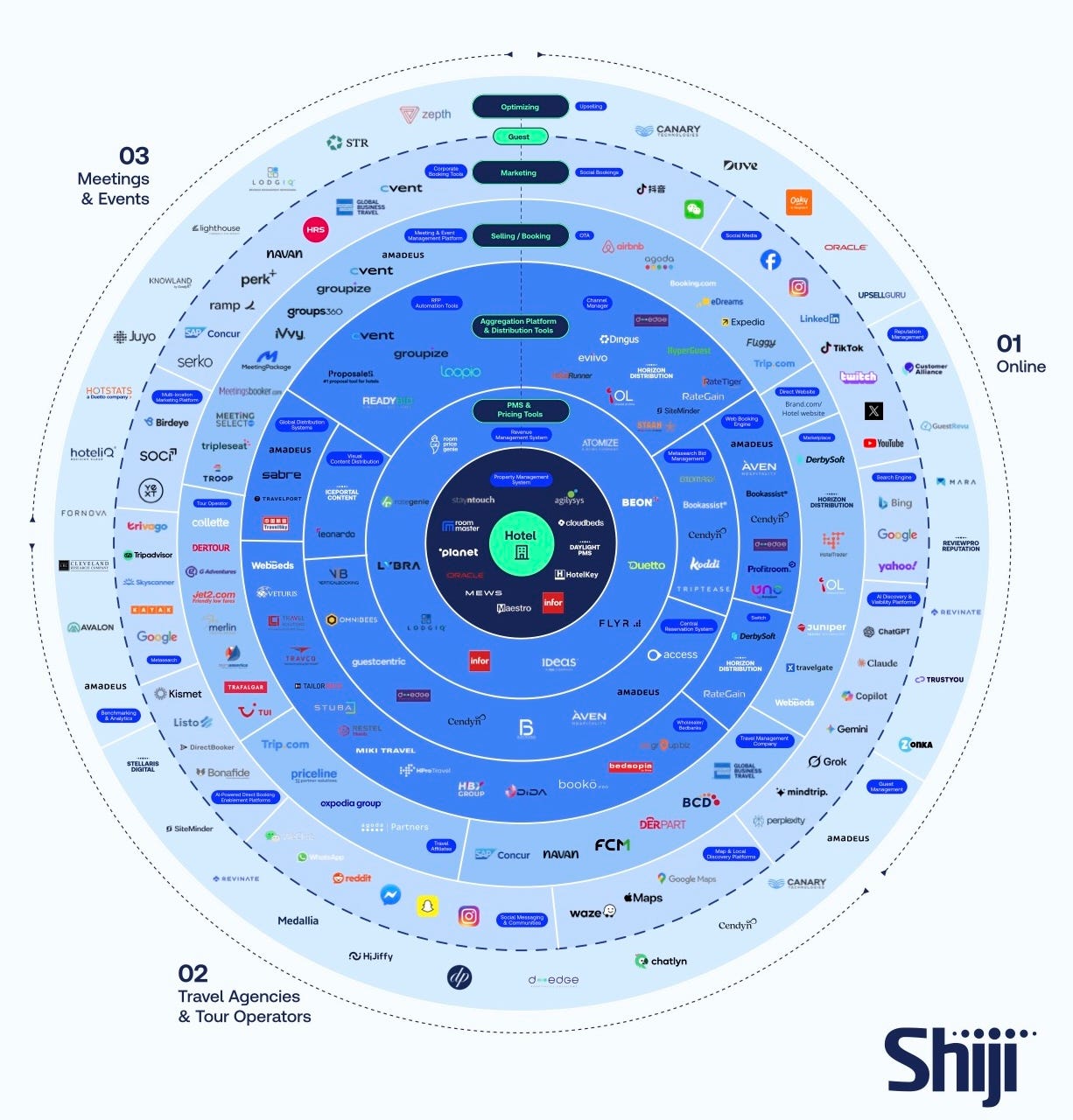
Hotel Tech Keeps Growing, and AI?
When I first created the hotel technology landscape chart back in 2015, it contained roughly 120 companies. At the time, it was often shared as a visual representation of confusion, showing how fragmented the industry was. But, what we were trying to map was how data moves in hotel tech, PMS to revenue management, to channel manager, to OTA, meta search, etc.
Today, the chart contains around 300 companies (and these are only the main players in each category) there are thousands of others. Yet, despite years of mergers, acquisitions, and consolidation, hotel technology keeps getting larger.
The question today is where does AI fit into all of this? Will it replace it all?
There is a narrative that AI will replace large parts of the software industry. The more time goes, the less I believe that will be the case. You cannot approximately process a payment. You cannot mostly connect to Booking.com. You cannot have an average room inventory. These systems exist because accuracy matters. The dark blue core of the chart is likely to remain very much intact.
There are three areas where I do think AI will bring change. The first is the analysis layer (outer rim). These solutions exist to help make decisions, assemble data, pre-analyze it etc. This is likely to change because AI dramatically lowers the cost of building tools around specific operational needs. Customizing Analytics and BI tools is a never-ending game of tweaking and customizing layouts. AI has a huge opportunity to bring conversational updates to these solutions.
The second one, as I have written before, there is an entire spreadsheet layer sitting between many of these systems. Almost every solution on this chart has a spreadsheet that works alongside it to tweak data, prepare information, etc etc. This is ripe for AI custom apps.
The third one I realized quite recently and deserves more attention. Customers, using Agentic AI, to adapt their systems to their own workflows. Most software vendors can’t adapt their products to every customer. Yet every bigger hotel has unique process needs. Using AI agents we could shift a large part of that work to the customer. Using plain language, tell the AI to create the workflow they need.
For example telling your AI Agent that all corporate payments should be routed through a different provider, approved through a specific workflow, and reported in a particular format. It designs the process, you approve it, and the workflow is implemented. Historically, that request (if approved by vendor) would have entered a product backlog and waited years to be developed. Or it would have turned into a spreadsheet automation as in point two above.
This could dramatically accelerate the pace of innovation in our industry. Core systems would continue providing the foundation while exposing more API data and documentation, capabilities etc. Customers would then use AI agents to adapt those systems to their own operational requirements rather than waiting for software vendors to do it for them.
So perhaps the real opportunity for AI is not another category, or another vendor. Instead of forcing hotels to adapt their processes to software, software may increasingly adapt to the hotel.
Which incidentally would make core systems exponentially harder to replace.
• Youtube Stars Making Movies - Link
• The Guide Competitors Hope You Miss - Link⁺
• A short story about Anatomy’s history - Link
• Nike Rips the Script - Link
• Robots 200 Million miles away - Link
Did you know: The word “professor” comes from the Latin word “professus,” meaning “having declared publicly.” It originally referred to someone who has declared their knowledge, especially a teacher. Over time, it came to mean a high-ranking teacher at a university or college. Defined using Lomar Dictionary⁺